
People do their best work
Assistants and agents take on chasing approvals, reconciling data and routine transactions, so teams spend their time on decisions and customers.
The Autonomous Enterprise is a new way for a business to run: AI understands context, coordinates work and executes routine processes across functions, while people lead. Here is what it is, how it works on SAP and how to get there.

Pilots prove AI works. But what works in one team rarely spreads, because most enterprises still run as a series of handoffs. Systems record what happened; people chase updates, reconcile numbers and coordinate the response. The gap between knowing and doing is where value is lost.
Every function works from its own version of the truth, so AI cannot act consistently across them.
Models process language well but do not know how your processes connect or how exceptions are handled.
Controls applied after the fact slow everything down and make leaders reluctant to let AI act.
In consumer apps, AI that is mostly right still helps. In the enterprise, a supplier payment cannot be mostly compliant and a regulatory filing cannot be mostly correct. Accuracy needs more than intelligence. It needs business context.
That context already lives in your ERP, the enterprise brain. It knows which suppliers support which products, how inventory affects production, how orders become revenue and which approvals govern a payment. The SAP Knowledge Graph makes that context readable by AI.
When conditions change, the business responds as one system. A supply disruption does not stay in a dashboard; it triggers a coordinated response across planning, procurement and operations, and the right person approves it.
| Approach | Process-led operations | Point AI adoption | Autonomous Enterprise |
|---|---|---|---|
| Primary focus | Recording and managing processes | Improving isolated tasks | Coordinating execution across the enterprise |
| How work moves | Sequential handoffs | Separate AI tools on top of workflows | Connected systems acting in real time |
| Role of AI | Limited automation and reporting | Copilots for specific use cases | Embedded in the operating model |
| Data and context | Fragmented across functions | Limited view of the business | Shared business context across apps, data and workflows |
| Governance | Controls applied after execution | Varies by tool or vendor | Built in from the start |
| Business impact | Visibility and standardisation | Incremental productivity | Enterprise-wide speed, adaptability and resilience |
Our job is to make each layer real in your landscape, from the clean core up, and to connect it to the non-SAP systems you already run.
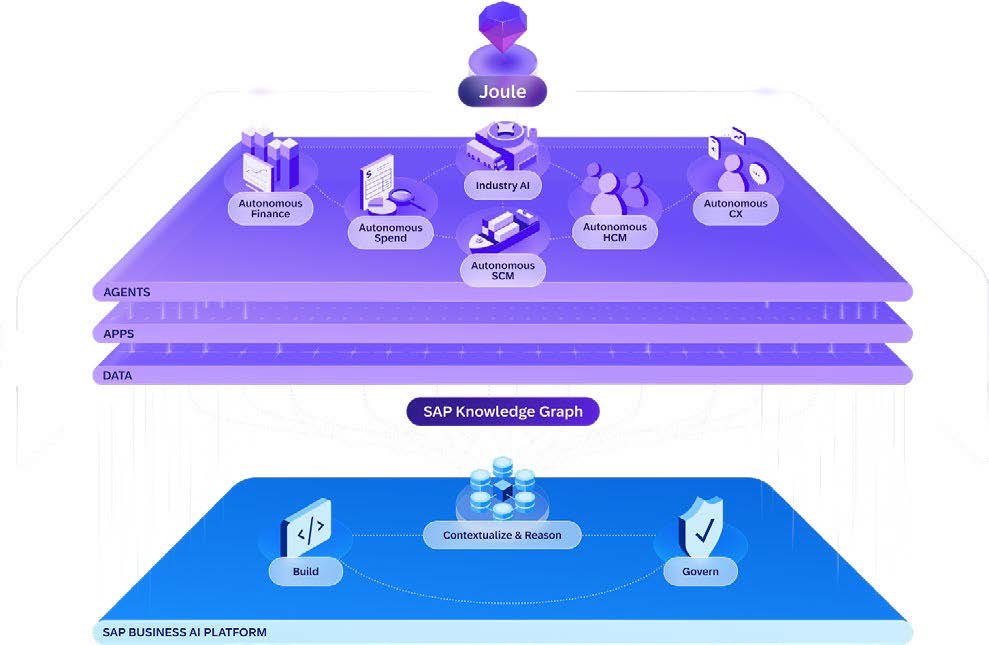
People should not have to move between dozens of applications, hunt for information across disconnected systems or stitch workflows together by hand. Joule is the front door to enterprise work: you say what you want to achieve, and AI gathers the right data, runs the necessary processes and coordinates action across SAP and third-party systems.
Behind each request, Joule pulls the relevant business data, works across systems and hands the task to the assistants and agents that can complete it.
Traditional software depends on people to move work from step to step: reviewing reports, spotting exceptions, sending emails, updating records and chasing other teams. The Autonomous Suite changes that model by putting AI assistants and agents inside core business operations.
They recommend, summarise information and coordinate activities, so each person gets to a decision faster.
They carry out defined tasks and business processes inside enterprise policies and controls, designed around real roles in finance, supply chain, procurement, HR and service.
Multiple agents share business context and work with people to keep operations moving, across SAP and non-SAP systems, and can be extended to fit your own processes.
An agent monitors inventory, spots a likely shortage, checks with suppliers, recommends alternative sourcing and starts the approved actions, before the disruption ever reaches a customer. Others manage financial close activities, reconcile data across systems or coordinate HR workflows.
The aim is not to replace human expertise. It is to remove the repetitive coordination that eats time and keeps people from strategic decisions.
Each area keeps its specialist applications, workflows and AI, while sharing context with the others, so a change in one cascades into coordinated action across all of them.
Alongside these, Industry AI adds sector-specific process knowledge and compliance. See how it applies in your industry.
Assistants and agents take on chasing approvals, reconciling data and routine transactions, so teams spend their time on decisions and customers.

When demand shifts, agents rebalance production schedules, adjust materials and prioritise orders before a planning cycle would even begin.

Every AI action is governed, auditable and traceable, so even regulated operations move faster without trading away control.
Autonomy does not remove human responsibility; governance matters more as AI takes on more. People stay accountable for strategy, ethics, exceptions and leadership. Most organisations are earlier on this path than they think, and that is fine. The next step is to do what matters, in the right order.
Tick the statements that are true now. This is a reflection tool, not a scorecard: it shows where you have momentum and where the gaps that stop AI from scaling are. Nothing is sent anywhere.
Every organisation starts somewhere different: a complex on-premise ERP, a hybrid landscape, or cloud ERP for the first time. With SAP Cloud ERP, in public or private cloud, AI assistants and agents are available from the first year, and the transformation itself can be agent-led: landscape analysis, custom-code remediation, data migration, testing and rollouts all accelerated by AI.
Tell us where your SAP landscape is today. We reply within one business day with an honest view of the best next step, even if that step is not us.